The Franklin Planner Era: Franklin Covey
Before the smartphone, before the tablet, before even the PDA was a common sight, I was a Franklin Planner guy. The big binder. The ruled pages. The values clarification worksheets in the back. Franklin's system was rooted in Stephen Covey's thinking — start with your values, define your roles, cascade down to goals and then to daily tasks. It was serious, deliberate, and honestly transformative for me. I carried that planner everywhere.
It was also heavy, and a little embarrassing to pull out at a standup meeting.
Freeworks and the QA Manager Role
In the early 2000s I was working as a QA Manager at Freeworks.com, a company doing online payroll before cloud software was even a common phrase. We were processing payroll over the internet at a time when most businesses still considered that somewhere between reckless and impossible. It was a fast-moving environment — development cycles, test plans, bug triage, release coordination, and a team to manage.
That's when I got serious about productivity.
A QA manager lives at the intersection of everything. You're coordinating with developers, talking to product, communicating with customers, tracking defects, building test cases, and watching deadlines that don't move. The Franklin Planner was good, but I needed something that could keep up with the pace and live in my pocket.
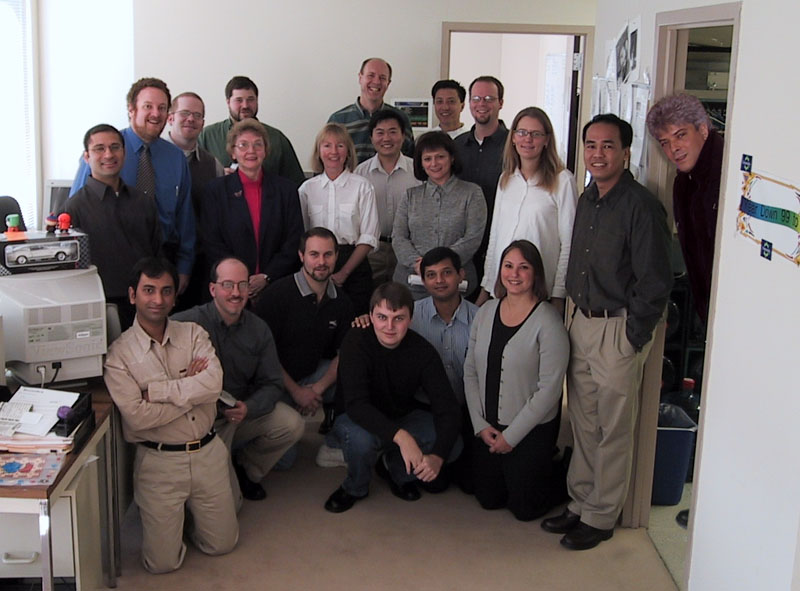
The Freeworks.com team — building online payroll before the cloud had a name.
Enter the Palm V
The Palm V was the device that changed everything for me. Thin, elegant, solid. It fit in a shirt pocket and actually stayed there. The Palm OS was simple and fast in a way that smartphones today — with all their power — sometimes still fail to be.
But the built-in apps were just the beginning.
The Big Three Apps
DateBk — Pimlico Software
My first serious productivity app on Palm was DateBk, built by Didier Chartier at Pimlico Software. DateBk was what happened when a developer who actually used a calendar decided to rebuild it from the ground up. Conditional repeating events, floating tasks that rolled forward until completed, custom icons in the day view, template entries, color-coded categories — and a week view that showed your tasks alongside your appointments. Dense with capability, never cluttered if you learned it. I learned it thoroughly. DateBk was the engine underneath my entire daily workflow.
Pocket Informant — Pocket Informant
Pocket Informant came at the same problem from a different angle. Where DateBk felt like a power tool built by an engineer, Pocket Informant had a more polished, structured approach — better task management integration, a cleaner visual design, and a Today screen that gave you genuine at-a-glance awareness of the day. There were real camps among Palm users — DateBk people and Pocket Informant people — the same way there were Emacs people and Vim people. I had a foot in both camps.
Agendus — iambic Software
Agendus brought something the others didn't emphasize: contact integration. It connected your appointments and tasks to the people associated with them. If you had a meeting with someone, Agendus made it easy to pull up their contact record, call history, and notes all from the same view. For a QA manager dealing with a lot of people across a lot of projects, that mattered. Agendus felt like a CRM-lite wrapped around a calendar. iambic eventually tried to make the jump to Windows Mobile and iPhone but never found the same footing — like a lot of great Palm software, perfectly tuned to that ecosystem and unable to survive the transition.
GTD Clicks Into Place
It was during the Freeworks years that David Allen's Getting Things Done landed in front of me, and something clicked hard.
GTD was the missing piece. Franklin had given me the values-and-goals scaffolding. DateBk and Informant and Agendus had given me the tools. But GTD gave me the system — the trusted inbox, the two-minute rule, the weekly review, the distinction between projects and next actions, the idea that your brain is for having ideas, not storing them.
Running GTD on a Palm V with DateBk was genuinely powerful. My tasks were captured, organized, and reviewed. My calendar was clean and reliable. My head was clearer than it had ever been at work.
What It Built
Looking back, those Freeworks years and that Palm V workflow built habits that never left me. The weekly review. The daily capture. Keeping a trusted system so you're not holding things in your head. Planning the day before it starts.
The tools have changed — the Palm is long gone, Agendus and DateBk faded with the platform, and Franklin planners live mostly in thrift stores now. But the thinking that emerged from that era still shapes how I work every single day.
Some things from the early days of tech turn out to be worth keeping.